An astrology planner for a month you can actually use
Build a monthly astrology planner with Moon phases, personal dates and one clear focus. See six real pages from the Monthly Compass sample.
By AstraRead Editorial · Updated
The short answer
A useful monthly astrology planner combines a calendar with personal context and space to act. Start with one focus, mark the Moon phases in your timezone, choose a few short checkpoints and review what actually happened.
Key points
- Moon phases provide a shared calendar; personal dates and birth-chart context add a different layer.
- Three short checkpoints are easier to use than treating most of the month as a special window.
- A planner earns its place by helping you make and review one realistic choice.
- Compare actual sample pages before choosing a printable planner or a subscription.
What belongs in a monthly astrology planner?
Look for four things: a readable calendar, a clear explanation of the personal information used, a small number of prompts and enough room to write. More symbols do not automatically make a planner more useful. You should be able to open it on your phone or print it, find your next checkpoint and understand what to do without decoding a wall of abbreviations. An annual planner offers a whole-year view; a monthly guide can respond to a focus you are still working on. Choose the format that fits how often you will return to it.
Use Moon phases as checkpoints
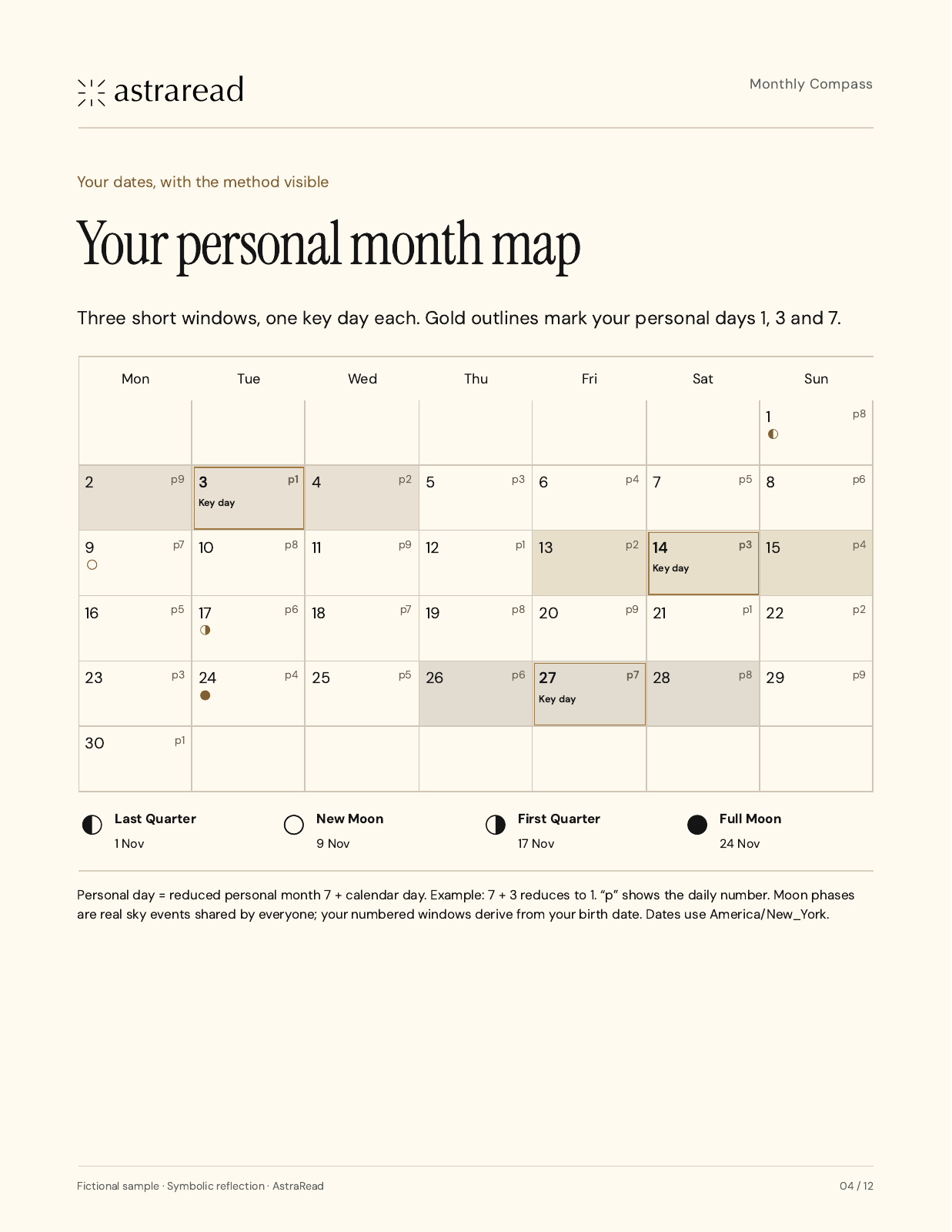
The lunar phase cycle lasts about 29.5 days, so it does not fit neatly inside every calendar month. Mark the actual phase dates rather than assuming the new moon is always near the first. A simple reflective routine is to name a focus near the new moon, check your first action around the first quarter, review visible results near the full moon and decide what to simplify around the last quarter. These are optional journaling associations. The phases describe the Moon’s appearance from Earth; they do not determine your mood or guarantee a result. Keep appointments and practical deadlines where they belong.
Choose one focus before filling the calendar
Choose something you can observe: clarifying a project, protecting an evening for rest or having one conversation you have postponed. Write one sentence about what would make the month useful. Then choose a small action you can take within your current time and resources. For a work focus, that might be sending a message that names the scope, owner and deadline. For rest, it could be turning one recurring evening into a quiet hour. A specific action gives the planner a purpose; a long list of intentions makes it harder to tell whether anything changed.
A practical example of three checkpoints
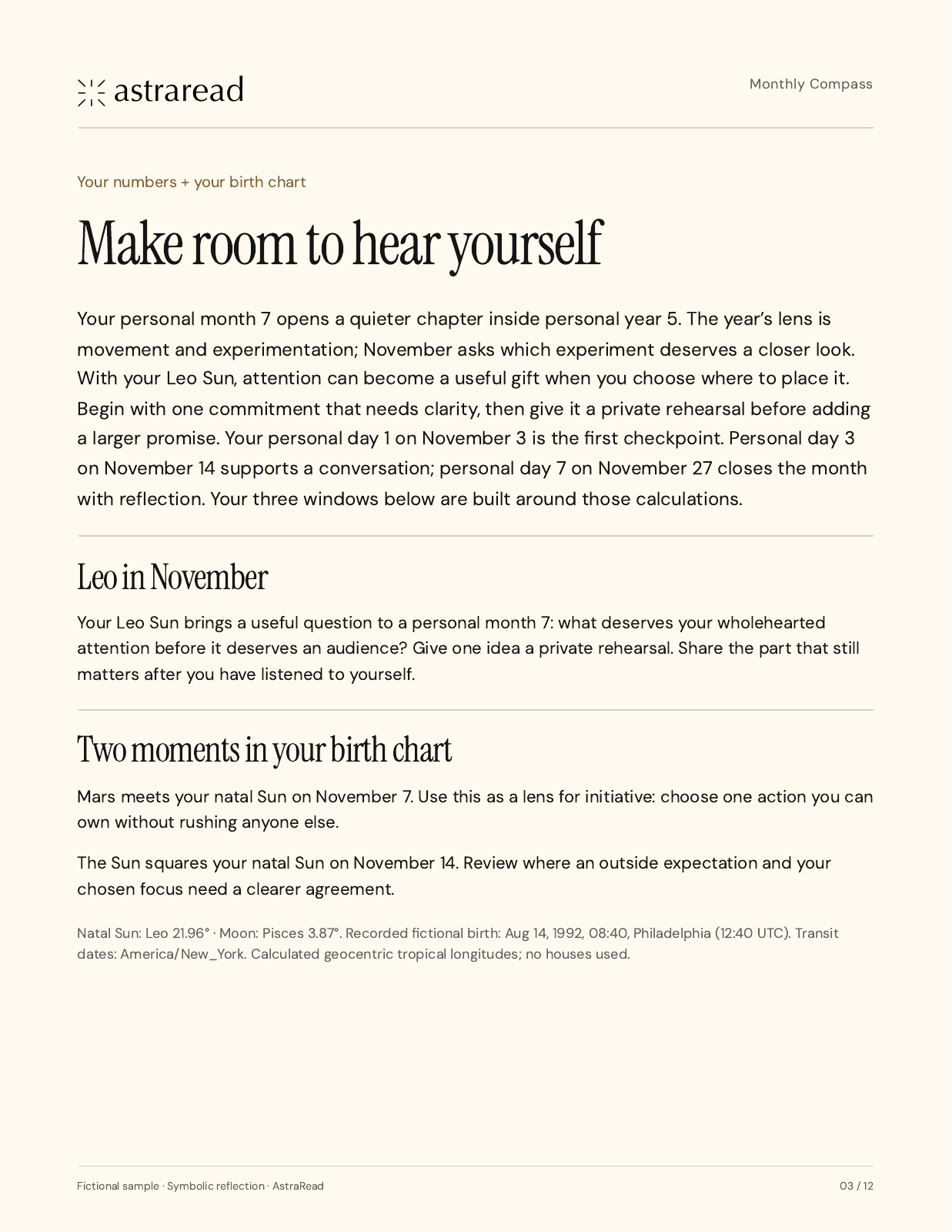
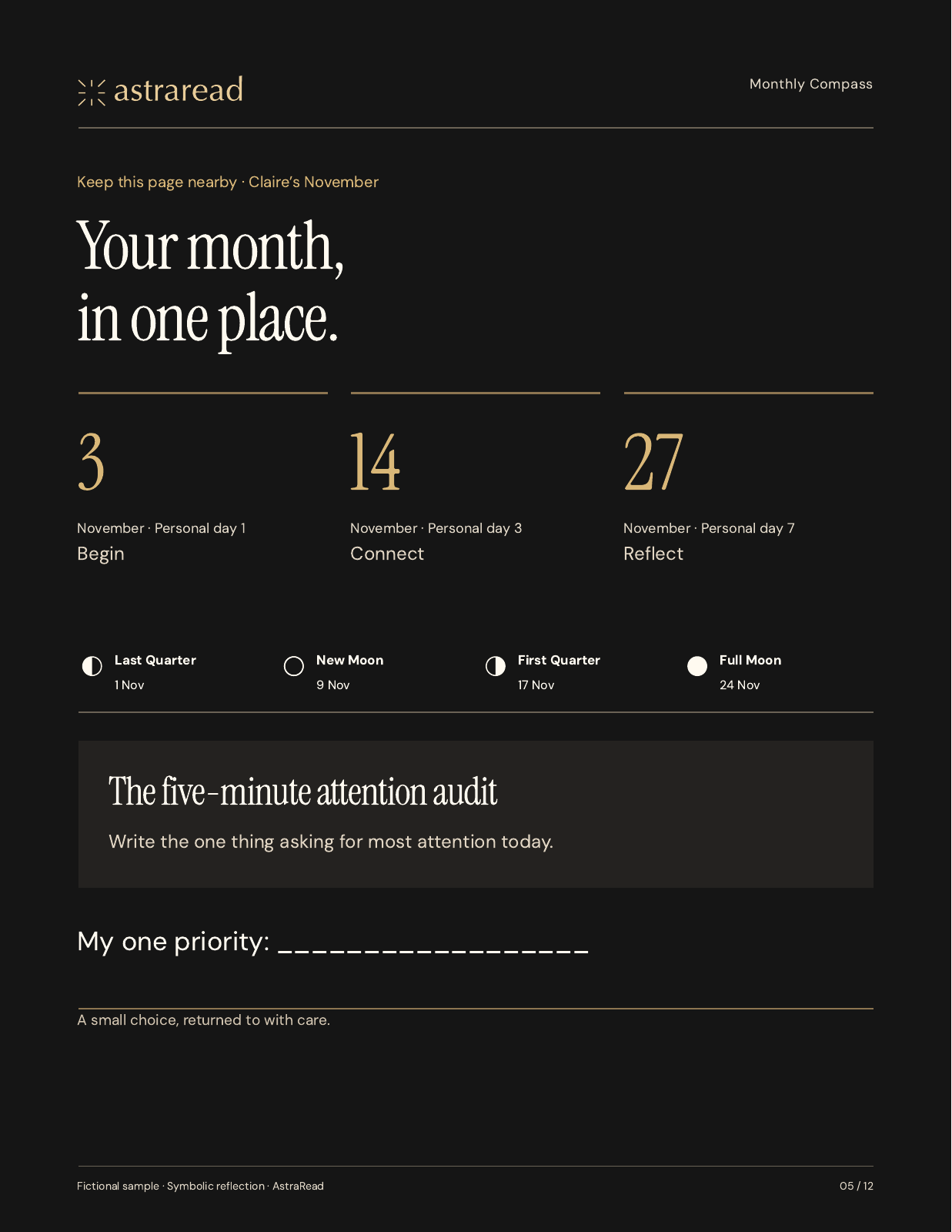
In the fictional November 2026 Compass sample, Claire has three key dates: November 3 for beginning, November 14 for connection and November 27 for reflection. The short windows around them come from the sample’s personal-day rules, rather than dates assigned to every reader. Claire could use the first checkpoint to define a small work experiment, the second to ask for clarification and the third to review the response. If a deadline falls outside those windows, she still meets it. Your dates may differ. The point is to make three manageable returns to one question, not to wait for permission from the calendar.
What if you do not know your birth time?
Use the information you genuinely know. Birth date supports the date-based parts of Compass; birth time and birthplace are optional. Without a reliable time, the guide keeps the personal-day calendar, Moon phases, practice and journal pages and omits natal transits that need that input. An empty time field should never silently become noon or another invented time. Your guide timezone is a separate setting: it controls local Moon-calendar dates and delivery timing, rather than standing in for your birthplace. A clear planner tells you which layer is available instead of presenting guessed chart detail as personal certainty.
An astrology journal should remember what you learned
At your final checkpoint, write three short notes: what you tried, what happened and what you want to carry forward. Include a result that did not fit the original theme. If an experiment felt so-so, reduce its size or change the question instead of blaming yourself for missing the right date. Next month, begin from that record. This is where a monthly planner becomes a useful astrology journal: it connects symbolic prompts to your own observations. You can do this in a notebook, a printed guide or a digital document. Consistency matters more than filling every blank.
See the delivered format before subscribing
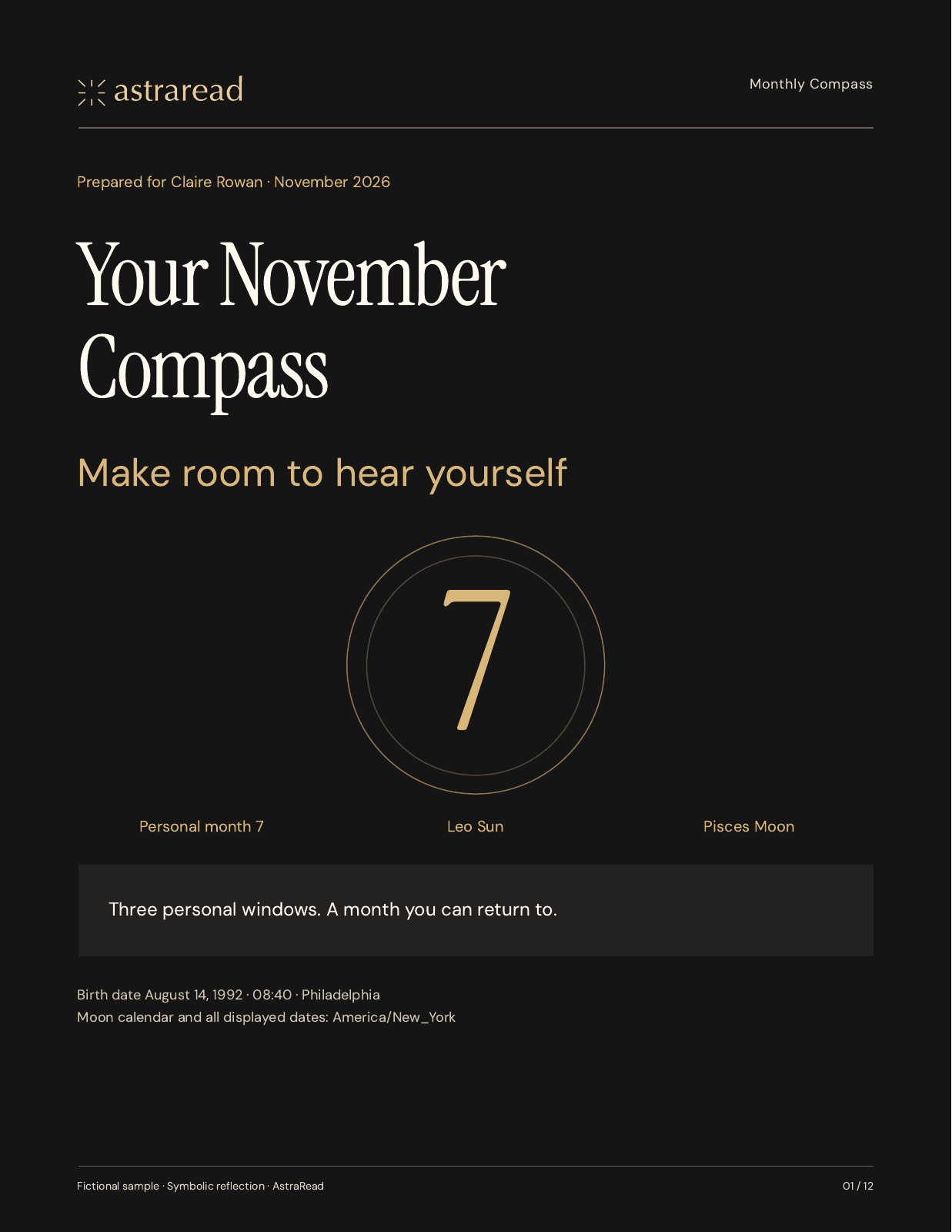
Monthly Compass brings these layers together in a personal PDF: an overview, Moon and personal-day calendar, short windows, a practice, journal prompts and a focus to revisit. The six pages below are actual pages from the approved fictional November sample, not invented layouts. Open any page to inspect the text and spacing, or read the complete PDF. Monthly membership is $14.90 USD; annual membership is $129 USD. The first monthly map covers the next calendar month. Foundation arrives at the start, and Core Blueprint is included in month two for monthly members or at the start of annual membership. Compare the current plans and delivery details on the Compass page before paying.
Inside the finished Monthly Compass
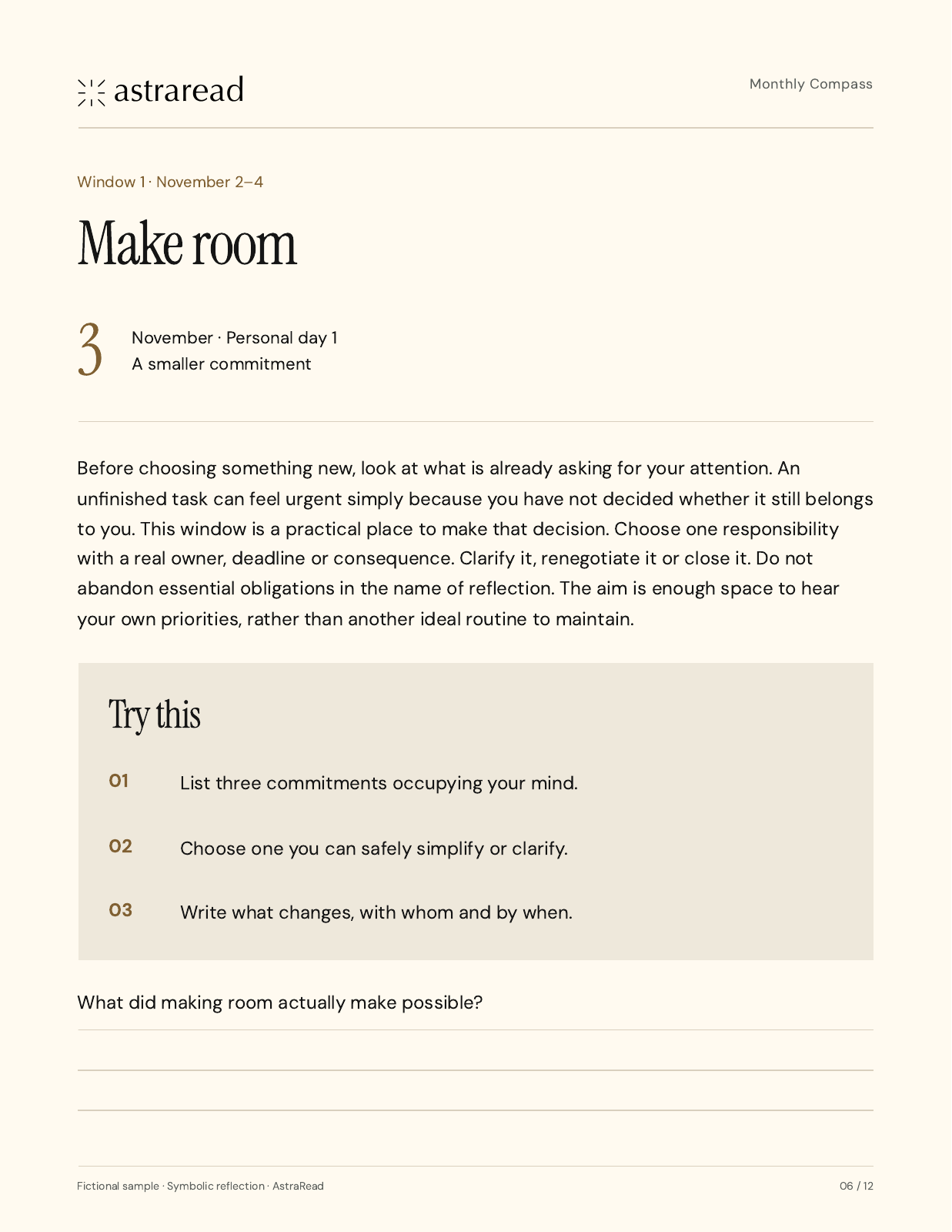
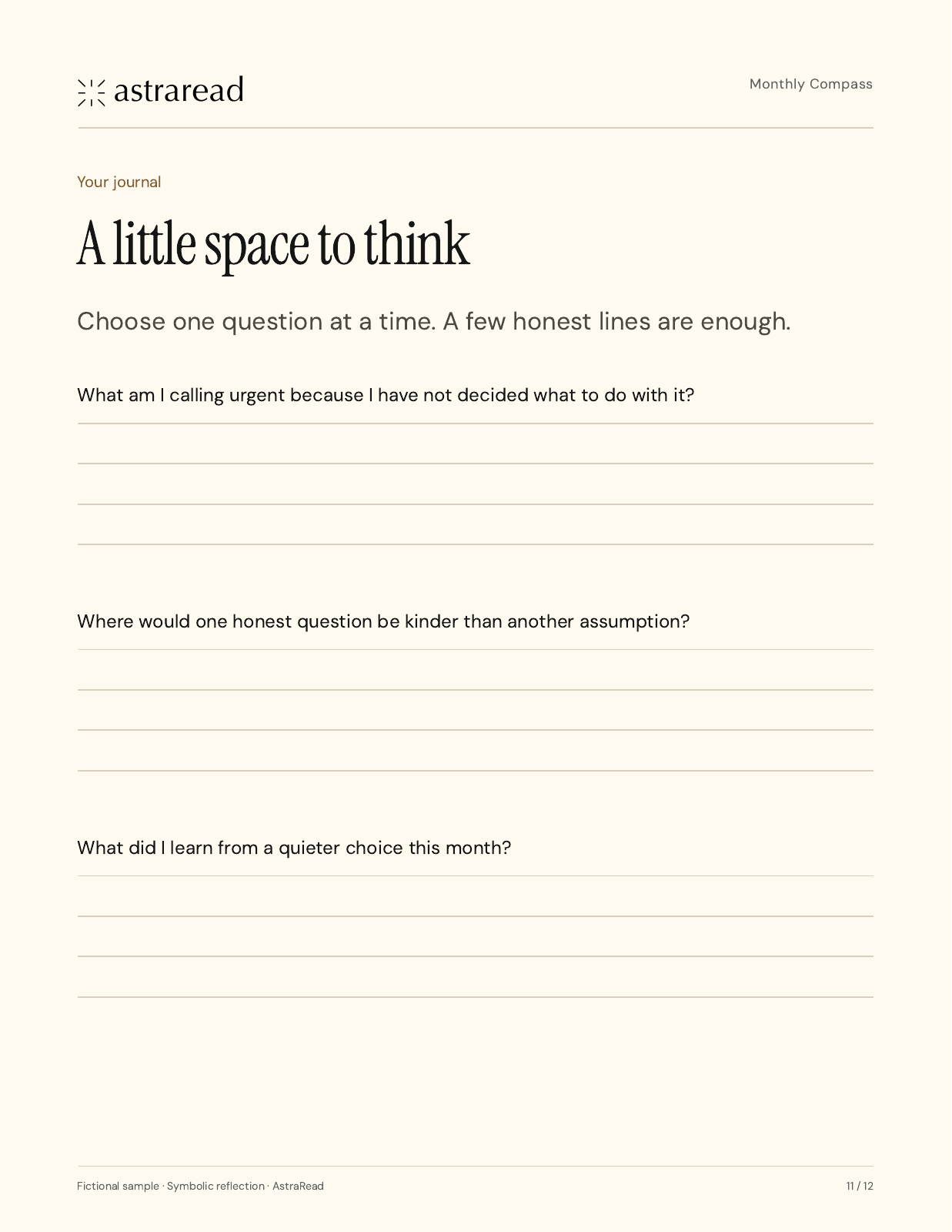
Six real report-page previews · fictional November 2026 sample. Open a page full size to read it.
Common questions
Is an astrology planner the same as a daily horoscope?
No. A planner provides a calendar, prompts and room to record choices. A daily horoscope usually provides a short interpretation for a sign. Check the sample to see whether personal information actually changes the planner.
Can I use a Moon phase planner without buying a subscription?
Yes. Mark phase dates from a reliable astronomical calendar in your own timezone and use a notebook for your focus and review. A subscription is a choice about a prepared personal format and continuity, not a requirement for this routine.
Does everyone get the same dates in Monthly Compass?
Moon phases are shared astronomical events. The Compass personal-day dates are calculated separately from birth-date information, and natal transits are included only when the required birth details are known.
Can I see the whole Compass PDF before subscribing?
Yes. The Compass product page provides the complete fictional November 2026 sample and six real page previews. The sample demonstrates the format; it is not a report calculated for you.
Sources and further reading
Continue with this topic
-
Personal month number: how to calculate it and use it
Calculate your personal month number from your birth date, understand the meanings 1–9 and turn a monthly theme into a practical reflection plan.
9 min read · Timing
-
How to use a 2027 year-ahead reflection map
Use a 2027 annual theme, quarterly focus and monthly prompts as a grounded planning ritual rather than a fixed forecast.
7 min read · Timing
-
What if I do not know my exact birth time?
Find your birth time in a long-form birth certificate, hospital record or family documents. Learn what remains reliable if the exact time cannot be found.
8 min read · How it works
Related personalized reports
Continue exploring
Browse all Journal guides or use the free Destiny Matrix calculator.