Personal month number: how to calculate it and use it
Calculate your personal month number from your birth date, understand the meanings 1–9 and turn a monthly theme into a practical reflection plan.
By AstraRead Editorial · Updated

The short answer
Using the calendar-year method, reduce your birth month, birth day and target year to a personal year number, then add the target calendar month and reduce again to 1–9. For an August 14 birthday, the 2026 personal year is 5 and the November personal month is 7.
Key points
- The personal year uses your birth month and day with the year you are planning.
- The personal month adds the calendar month to that personal year.
- AstraRead uses calendar-year timing and reduces monthly numbers to 1–9.
- Treat the theme as a question to explore, then check it against your own experience.
What is a personal month number?
A personal month number is a numerology theme for one calendar month, calculated from your birth month and day and the year and month you want to explore. It sits inside a personal year theme: the year offers a broad question, while the month provides a smaller focus. Numerology assigns symbolic meanings to these numbers; the arithmetic does not establish that they cause events or predict an outcome. You can use the theme to choose a journaling question, notice a familiar response or design a small experiment. It is most useful when the calculation method is visible and the interpretation leaves room for things that do not fit.
How to calculate your personal month
First, add the digits of the target year and reduce the total to one digit. For 2026, 2 + 0 + 2 + 6 = 10, then 1 + 0 = 1. Next combine your birth month, reduced birth day and reduced target year. For an August 14 birthday, that is 8 + 5 + 1 = 14, then 1 + 4 = 5: personal year 5. Finally add the target month. November is month 11, so 5 + 11 = 16, then 1 + 6 = 7: personal month 7. The birth year is not part of this calculation. Write the target year and month beside the result so you do not confuse this month’s theme with a permanent number.
Personal month 1: beginning
Use the theme of beginning to name one thing you would like to start, rather than starting everything at once. A useful question is: what is the smallest first step I can take with the resources I already have? That might be outlining a project, asking a question or reserving twenty minutes to try an idea. Notice whether enthusiasm is helping you act or making your plan too large. You do not need a perfect date or a complete new identity. At the next checkpoint, review what your first step taught you and decide whether the experiment deserves another step.
Personal month 2: cooperation
A cooperation theme can invite closer attention to listening, pacing and shared expectations. Ask where a little clarification would make a relationship or project easier. Try repeating back what you understood before proposing a solution, or agree on who owns the next task. Cooperation does not require accepting every request or avoiding disagreement. Notice whether patience is making room for useful information or becoming a way to postpone your own needs. A concrete boundary can support a connection. Review the exchange afterwards: did both people understand the agreement, and is the next step realistic for each of you?
Personal month 3: expression
Expression can be a prompt to make an idea easier to share. Choose one form: a short message, a conversation, a sketch or a page of writing. Ask what you want someone to understand, then remove the extra explanation that obscures it. You might try sending a clear invitation instead of waiting for another person to infer your interest. Watch for the difference between enjoying expression and seeking a response you cannot control. Record what you communicated and what you learned. An honest, small attempt is more useful than judging the month by how much attention you received.
Personal month 4: structure
Structure invites you to look at the systems that make ordinary life easier. Choose one recurring friction: an unclear deadline, a cluttered workspace or a routine with too many steps. Try a small adjustment, such as writing the owner and due date beside a task or preparing something the evening before. Avoid turning organization into a demand for perfection. A structure earns its place when it reduces effort, not when it creates more maintenance. At the end of the experiment, ask what became simpler and which rule you can remove. Keep the part that supports you.
Personal month 5: flexibility
Flexibility can help you examine where a routine needs another option. Ask what you could change without abandoning everything that already works. Try a different route, schedule or approach on a small scale, with a clear limit on time and cost. The theme is not a reason to make an impulsive purchase or a major life decision. Notice whether variety brings useful information or simply distracts from an uncomfortable task. Compare the experiment with your usual approach. If it helps, repeat it deliberately; if it does not, you have learned something without having to force the change.
Personal month 6: care and responsibility
Care can bring attention to the balance between supporting others and maintaining your own capacity. Choose one responsibility that needs a clearer agreement. You might offer a specific amount of time, ask for help or make a shared task visible. A useful question is: what can I give willingly, and what needs a boundary? Avoid measuring your value by how much you carry. Review whether the arrangement left room for rest and whether another person understood what you could offer. Small, repeatable care often serves a relationship better than an expansive promise you cannot sustain.
Personal month 7: reflection
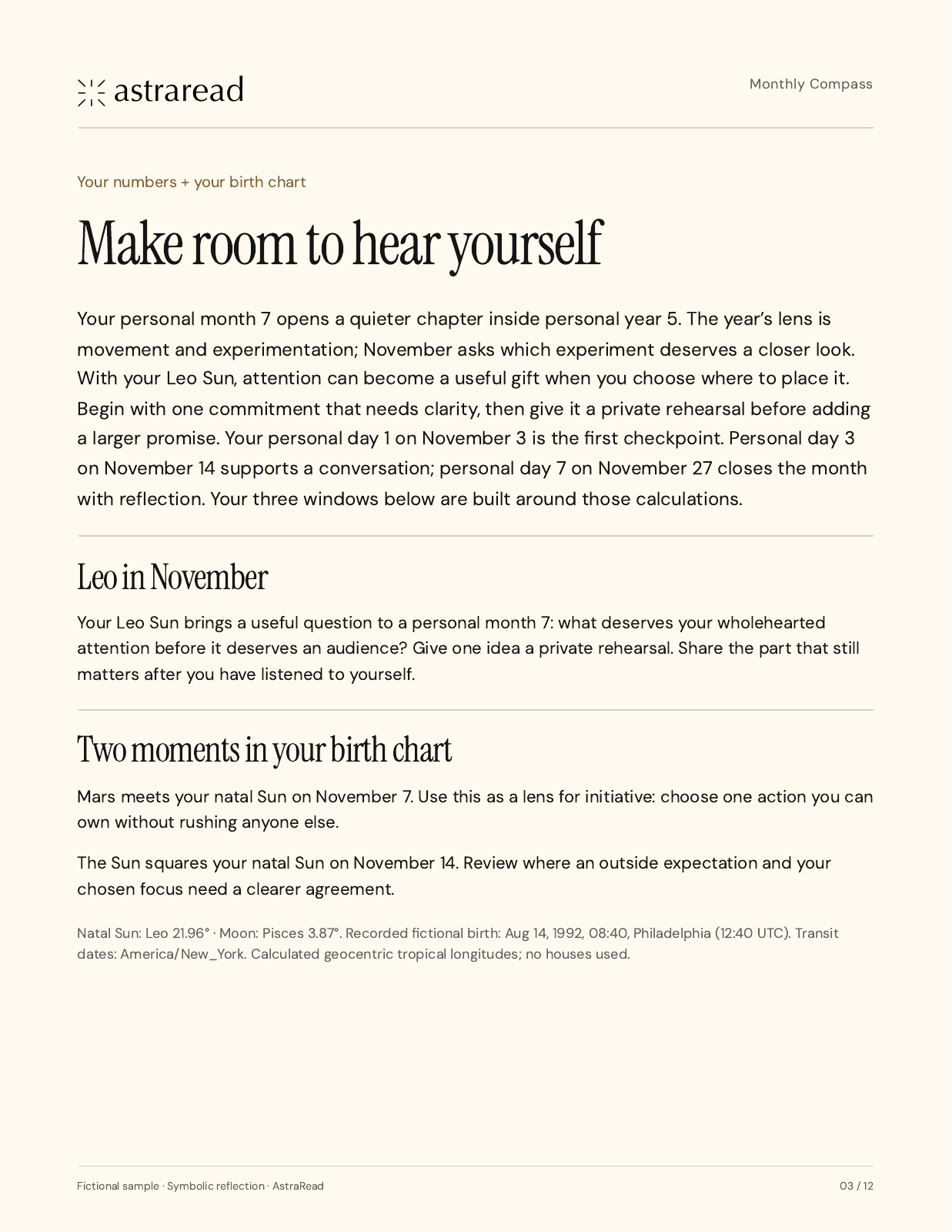
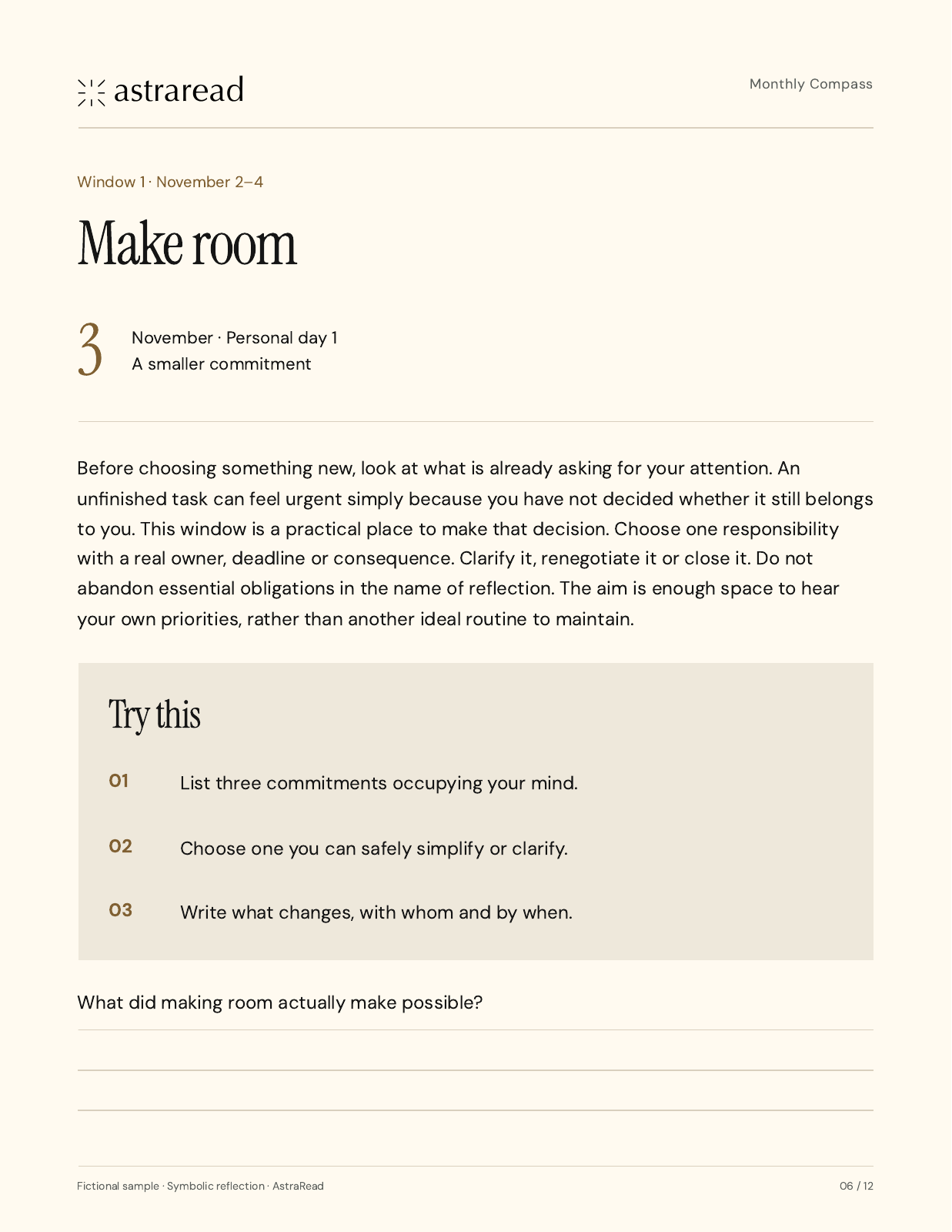
Reflection invites space to investigate a question before adding more activity. Choose something you want to understand and reserve a short, quiet interval to read, write or review your notes. In Claire’s fictional November sample, personal month 7 provides this kind of theme. It does not mean she must withdraw from people or that work will slow down. Ask what is becoming clearer and what still needs evidence. Watch for reflection turning into endless analysis. One observation followed by one modest action can be enough. Keep a record of exceptions as well as patterns.
Personal month 8: stewardship
Use stewardship as a question about how you handle resources, responsibility and decisions. Choose something concrete: a project’s scope, the time a commitment requires or the information you need before agreeing. Try making the trade-off explicit. What does this choice cost in attention, and what would make it worthwhile? The number does not promise income, promotion or success. It can provide a useful reason to review an agreement against reality. Notice where confidence helps you state a need and where it makes you overlook a constraint. Keep decisions grounded in facts and qualified advice where needed.
Personal month 9: completion
Completion can be a prompt to review what you are carrying forward. Choose one unfinished loop and decide whether to finish it, reduce it or consciously stop. This might be sending a closing message, filing notes or admitting that an experiment no longer serves its purpose. You do not need to end a relationship or leave a job because a number suggests closure. Ask what you have learned and what deserves a clean handoff. A small act of completion can create room without a dramatic change. Record what you want to retain before moving into the next month.
Personal month vs personal year vs personal day
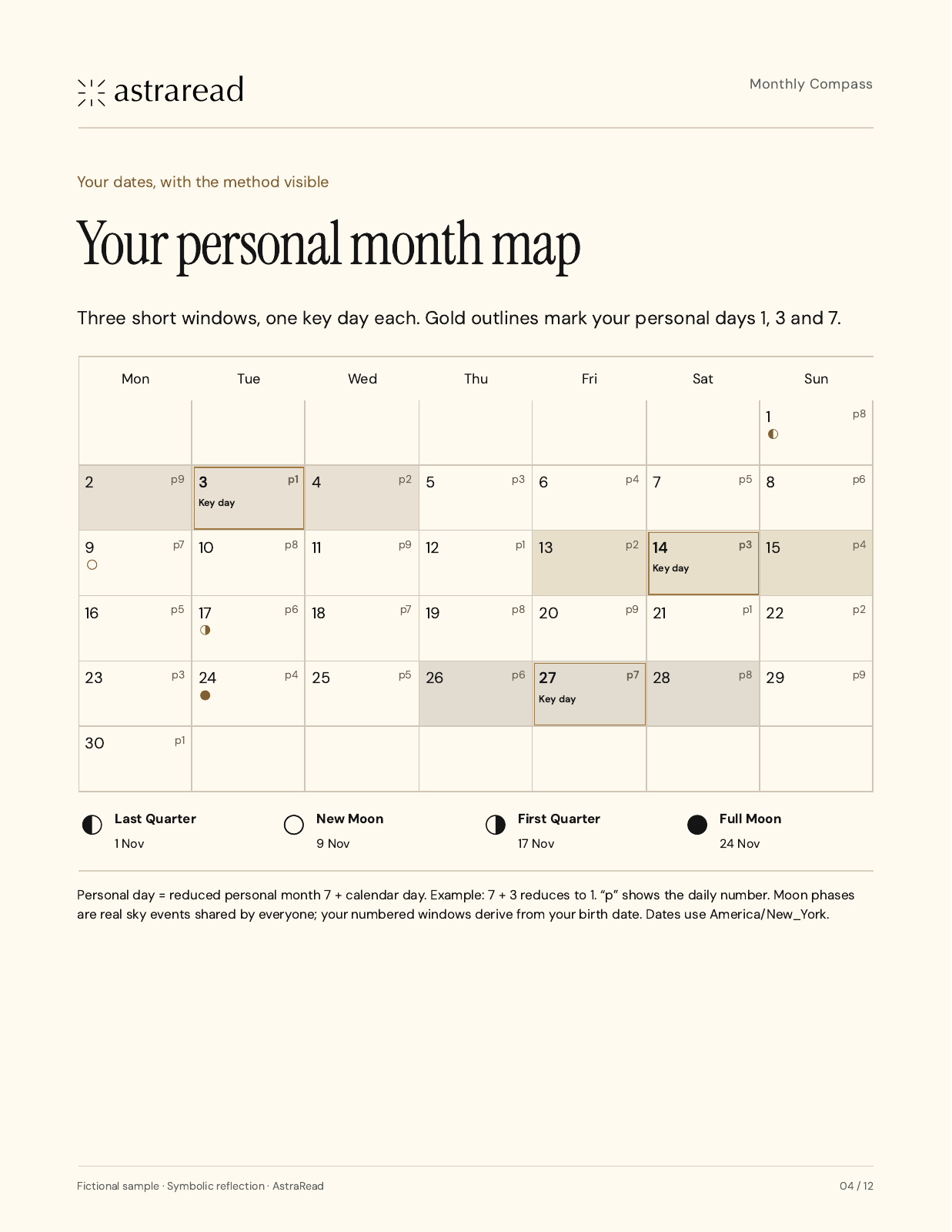
These are three levels of the same date-based convention. The personal year provides the broad annual theme. The personal month combines that year number with the calendar month. The personal day combines the personal month with a date within that month and reduces to 1–9. For Claire’s personal month 7, November 3 gives 7 + 3 = 10 → 1; November 14 gives 7 + 14 = 21 → 3; November 27 gives 7 + 27 = 34 → 7. Compass selects a few short windows from personal days rather than labelling most dates special. Moon phases are a separate astronomical calendar, not a numerology calculation.
Why two numerology sites may give different answers
Check the convention before comparing the interpretation. Some systems begin the personal year at the birthday; others begin on January 1. Some retain master numbers at particular stages, while others reduce every result to 1–9. AstraRead Compass uses a calendar-year method: the year changes on January 1, the personal month changes on the first day of the calendar month and monthly values are reduced to 1–9. A result of 11 therefore becomes 2 in this method, and 22 becomes 4. A different convention can produce different labels. The important thing is to name the method and apply it consistently rather than presenting one site’s result as an unexplained correction of another.
Turn your number into a monthly practice
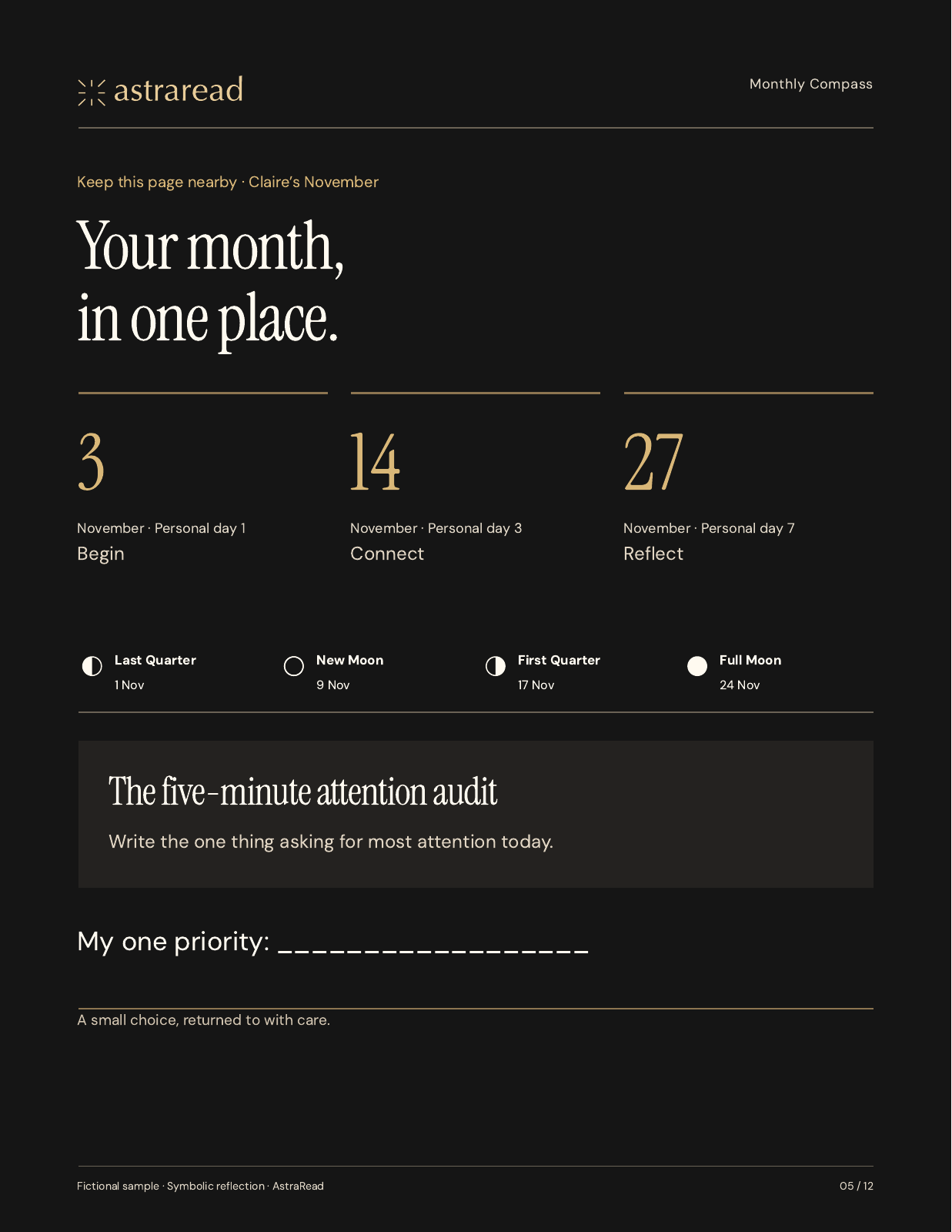
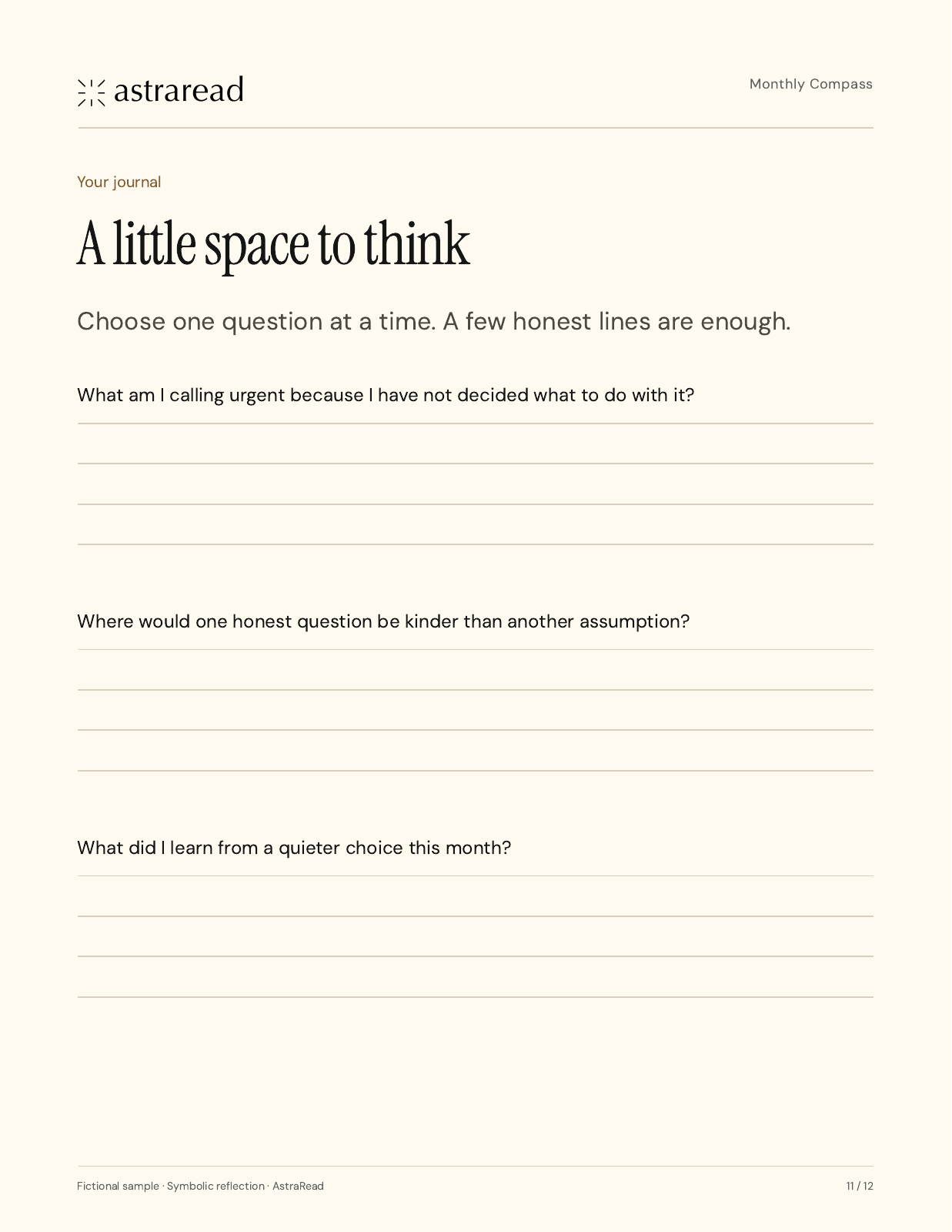
Start by writing one question inspired by the theme. Choose a realistic action, then pick a few dates to return to it. At the final checkpoint, record what you tried, what happened and what you will adjust. Keep the dates subordinate to real deadlines and your own circumstances. Monthly Compass prepares this structure in a personal PDF with a calendar, three short windows, Moon phases, practice and journal pages. The actual pages below show how the approved fictional November guide turns personal month 7 into a usable format. Read the whole sample before deciding whether you prefer your own notebook or a prepared monthly membership.
Inside the finished Monthly Compass
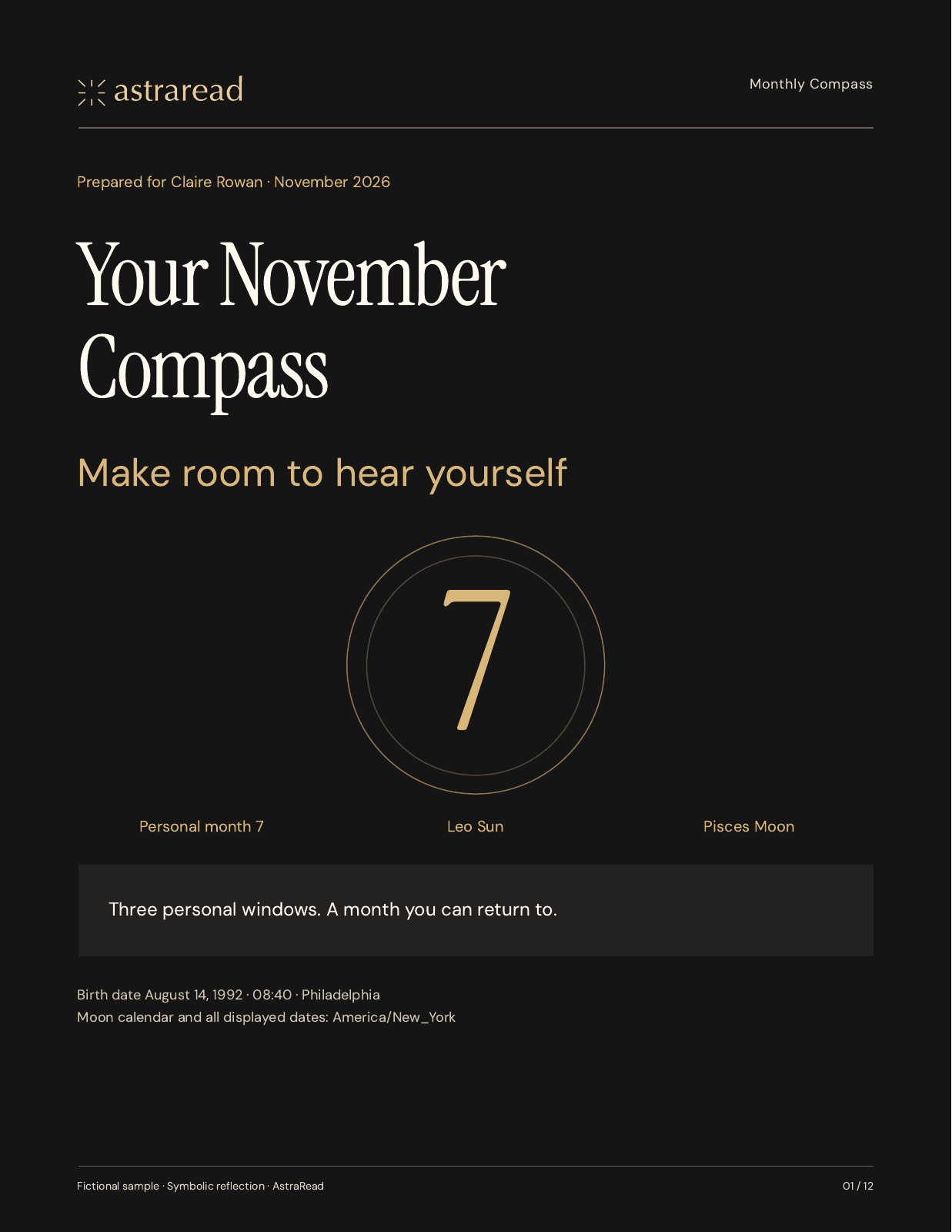
Six real report-page previews · fictional November 2026 sample. Open a page full size to read it.
Common questions
Does my personal month start on the first or on my birthday?
In the calendar-year method used by Compass, it starts on the first day of the calendar month. Birthday-based systems use a different convention, which should be stated clearly.
Do I need my birth time to calculate a personal month?
No. The numerology calculation uses your birth month and day and the target year and month. Birth time and birthplace are separate, optional inputs for natal-chart content.
What happens to master numbers 11 and 22?
Compass reduces monthly values to 1–9, so 11 becomes 2 and 22 becomes 4. Other numerology conventions may retain them. Compare methods before interpreting a difference.
Is a personal month number a prediction?
No. The arithmetic is reproducible, but the assigned meanings are symbolic. Use them for reflection and planning rather than to predict events or replace evidence.
Can my personal month number repeat?
Yes. Single-digit themes repeat as the cycle continues, and different people can share a number. Your choices, circumstances and recorded focus provide context beyond that number.
Sources and further reading
Continue with this topic
-
An astrology planner for a month you can actually use
Build a monthly astrology planner with Moon phases, personal dates and one clear focus. See six real pages from the Monthly Compass sample.
7 min read · Timing
-
Life Path vs Expression vs Soul Urge: what each number uses
Compare Life Path, Expression and Soul Urge numbers by input, calculation and purpose, with a transparent fictional example and clear limits.
9 min read · Symbols
-
How to use a 2027 year-ahead reflection map
Use a 2027 annual theme, quarterly focus and monthly prompts as a grounded planning ritual rather than a fixed forecast.
7 min read · Timing
Related personalized reports
Continue exploring
Browse all Journal guides or use the free Destiny Matrix calculator.