Why do I keep choosing the wrong partners?
Notice the evidence behind repeated attraction, unavailable partners and familiar relationship loops without turning the pattern into self-blame or diagnosis.
By AstraRead Editorial · Updated
The short answer
Choosing similar partners can reflect a familiar attraction cue, a need that becomes visible only after closeness begins or an early warning sign that is repeatedly explained away. The useful question is not “What is wrong with me?” but “Which sequence repeats, and where did I still have a choice?”
Key points
- Compare repeated behaviors, not labels or zodiac signs.
- Attraction and emotional availability are separate questions.
- The earliest flexible moment usually appears before the relationship feels urgent.
- A pattern can explain a choice without excusing disrespect or harm.
Replace “wrong person” with an observable pattern
Start with three relationships or dating experiences and write only what could have been observed: how quickly contact intensified, how plans were made, whether words matched actions, what happened when you asked for clarity and how repair worked after disappointment. “Unavailable” may be a useful conclusion later, but first collect the behavior that supports it.
Separate attraction from availability
Chemistry can arrive before there is evidence of consistency, emotional capacity or shared intention. Ask what creates the first pull and then ask a different question: what did this person repeatedly make available in time, care, honesty and repair? Keeping those columns separate prevents intensity from doing the work of evidence.
Notice what familiarity is doing
A familiar dynamic can feel easy to recognize even when it is difficult to live inside. You may know how to pursue, wait, prove, rescue or stay self-sufficient in that pattern. Familiarity does not prove that a childhood story or attachment label caused the choice; it simply points to a role you already know how to perform.
Find the first moment you explained away data
Look for the earliest mismatch that mattered: a boundary treated as negotiable, affection without follow-through, a disappearing act followed by intensity or a conflict in which only one person repaired. Write what you noticed, the explanation you gave it and what additional evidence you waited for. This is often a more useful choice point than the final breakup.
Name the need beneath the repetition
A repeated choice may protect hope, avoid loneliness, preserve a self-image or keep you from asking directly for what you want. The need is not a flaw. Naming it lets you look for another way to meet it—for example, moving more slowly, asking a clear question or keeping support and routines intact while a connection develops.
Design one early-stage experiment
Choose one small practice for the next dating experience: do not interpret mixed signals for the other person, notice how they respond to one ordinary boundary or wait for consistent action before increasing emotional investment. Give the experiment a review point. The aim is not perfect partner selection; it is better information before the cost of leaving becomes high.
Keep safety outside the reflection exercise
Self-reflection is not a reason to share responsibility for coercion, manipulation, threats or abuse. A symbolic report can help organize a personal question, but it cannot assess safety, diagnose another person or replace qualified mental-health, domestic-violence or legal support. Immediate safety takes priority over understanding the pattern.
Common questions
Does choosing similar partners mean I have a fixed attachment style?
No. Repetition alone does not establish a diagnosis or permanent style. Look at specific behavior, context and exceptions, and seek qualified support if you want a clinical assessment.
Can a love pattern reading tell me who to date?
No. It can organize reflection on your own attraction, protection and repair patterns, but it cannot evaluate a stranger, guarantee compatibility or choose a partner for you.
What if the pattern involves abuse or coercion?
Prioritize safety and qualified support. Reflection should never redistribute responsibility for another person’s harmful behavior or delay practical protection.
Continue with this topic
-
Why relationship patterns repeat—and how to notice them
A grounded way to observe repeating relationship triggers, protection strategies and repair attempts without turning a pattern into a diagnosis.
9 min read · Relationships
-
What is a love pattern reading?
Learn what a personalized love pattern reading explores, which details it needs and how it differs from compatibility tests, therapy and prediction.
8 min read · Relationships
-
Single on Valentine’s Day: 12 grounded reflection questions
Use 12 grounded reflection questions to navigate being single on Valentine’s Day without treating relationship status as a problem to solve.
9 min read · Relationships
Related personalized reports
-
Personal Reflection Report
An 18-page personal report built from your first name and birth date, with patterns across self, relationships, work and change.
18 pages · $11.90 USD · Your first report when several parts of life feel connected
-
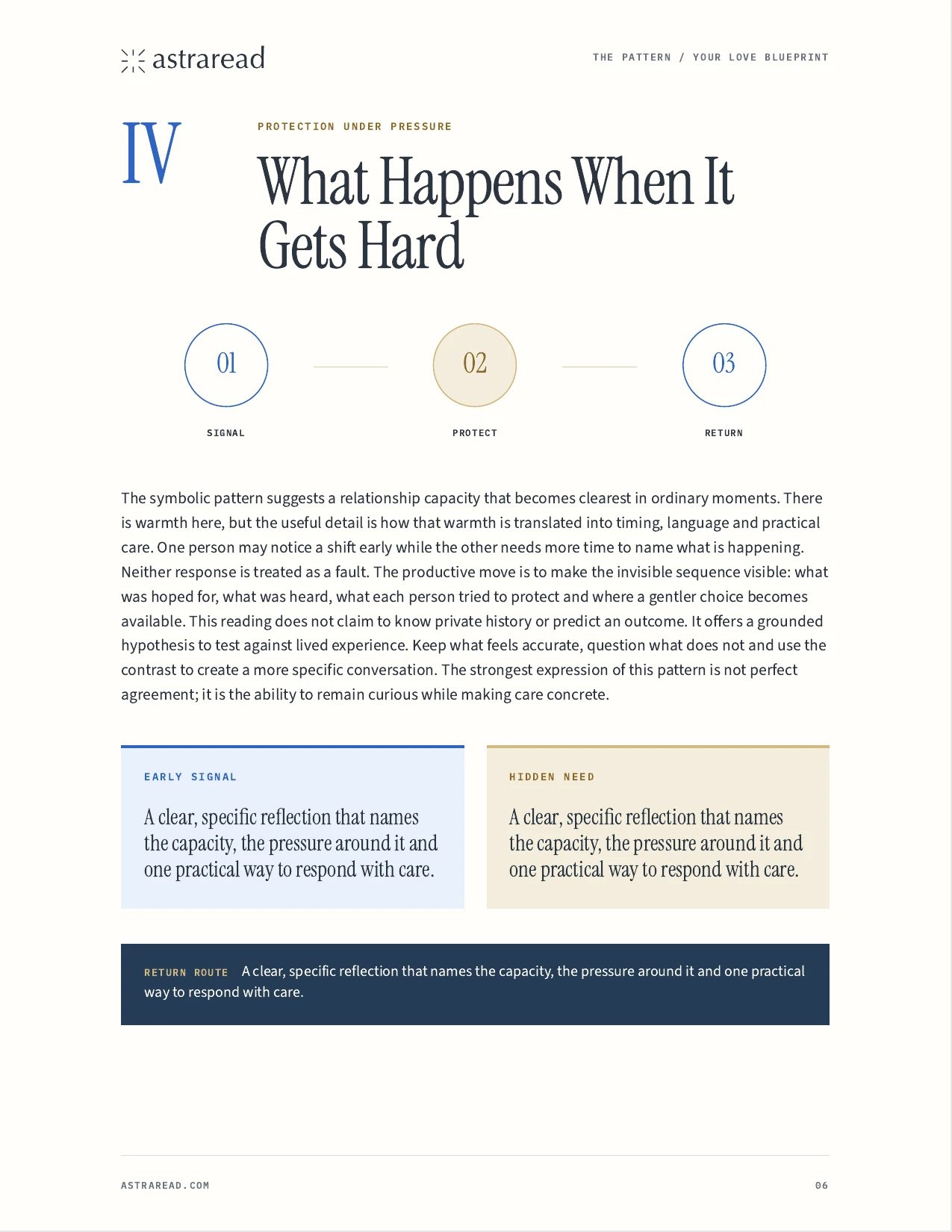
THE PATTERN · Your Love Blueprint
Notice the relationship pattern you bring into closeness, self-protection, conflict and repair.
15 pages · $24.90 USD · Solo reflection on recurring love patterns
Continue exploring
Browse all Journal guides or use the free Destiny Matrix calculator.