Free astrocartography chart calculator
Free astrocartography chart: enter your birth date, time and place to see all 40 planetary lines on a world map and the cities closest to them. No email needed.
By Oleh Khmelnytskyi, founder and editor, AstraRead · Updated
The short answer
An astrocartography chart draws your birth chart on a world map. For each planet it shows four lines: where the planet was rising (AC), setting (DC), highest in the sky (MC) and lowest (IC) at the moment you were born. Enter your birth date, exact time and place below and the map is calculated in your browser, with a list of world cities near your lines.
Key points
- Ten planets, four lines each: 40 lines in total.
- Birth time matters: four minutes of error moves every line by about one degree of longitude.
- Places within a few hundred kilometres of a line are read as carrying that planet’s theme.
- The calculation runs on your device. Nothing is stored or sent.
How to read your astrocartography map
Start with the lines closest to places you know: where you were born, where you live, where you felt unusually good or unusually stuck. Vertical lines are the Midheaven (MC, career and public life) and the IC (home and roots). Curved lines are the Ascendant (AC, how you come across) and the Descendant (DC, partnership). The planet tells you the theme and the angle tells you the area of life.
What each planet line means
Sun: identity and visibility. Moon: emotional life and belonging. Mercury: learning, writing and trade. Venus: love, beauty and ease. Mars: drive, courage and friction. Jupiter: growth and opportunity. Saturn: discipline and lasting work. Uranus: change and independence. Neptune: imagination and blurred boundaries. Pluto: intensity and transformation. No line is simply good or bad; each describes what a place tends to bring forward.
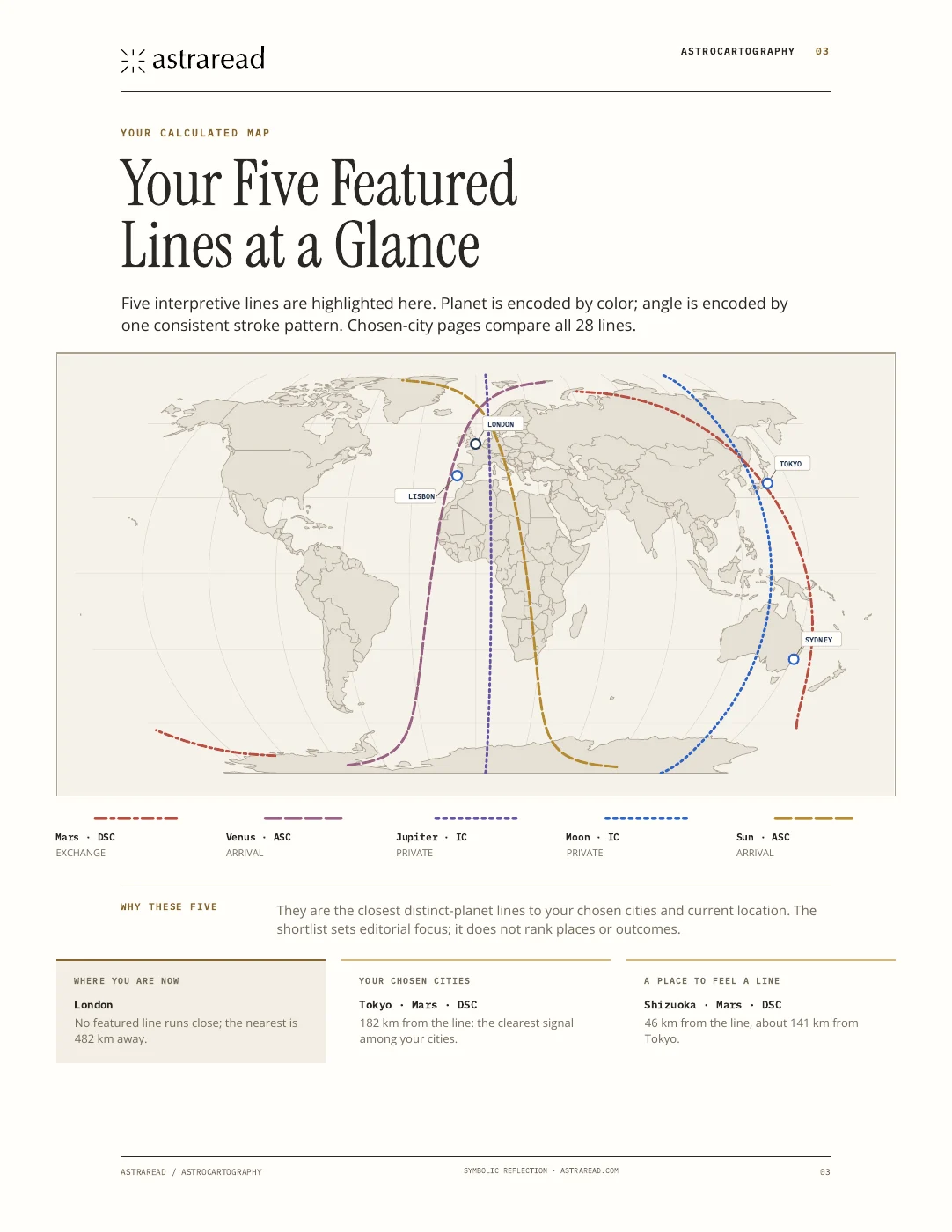
How close do you need to be to a line?
Most astrologers treat a line as strongest within about 150–250 km and noticeable up to roughly 600–700 km. This calculator lists world cities within about 400 km east or west of a line. Being between lines is normal and not a negative sign; it simply means no single planet dominates there.
Why exact birth time matters
The Earth turns one degree every four minutes, so the whole pattern of lines slides east or west with the clock. A birth time that is 20 minutes off moves every line by about 5 degrees of longitude, which can be several hundred kilometres. If you do not know your birth time, read the guide on astrocartography without a birth time before relying on a map.
How this calculator works
Your local birth time is converted to Universal Time using the time zone rules for the birth place on that date. Planet positions are then computed with an open-source astronomical library and converted to lines with standard spherical astronomy: the MC line is where the planet was on the meridian, and the AC and DC lines are where it was on the horizon. The map uses a simple equal-spacing projection, so lines near the poles are stretched.
Free chart and personalized report
The free chart shows where your lines are. A personalized Astrocartography report explains what they mean together: which lines are strongest for you, which cities fit the goals you name, and how the themes of a place may feel in daily life.
Common questions
Is this astrocartography chart really free?
Yes. The full map, the planet toggles and the list of cities near your lines are free, with no email or account. The calculation happens in your browser.
Do I need my exact birth time for astrocartography?
For a reliable map, yes. Four minutes of error shifts every line by about one degree of longitude. Without a birth time the vertical and curved lines cannot be placed accurately.
What is the best line to live on?
There is no single best line. People often look at Venus, Jupiter and Sun lines for ease, growth and visibility, but the right place depends on what you want from it. Use the map as a prompt for reflection, alongside practical factors.
What do AC, DC, MC and IC mean?
AC is the Ascendant (the planet was rising), DC the Descendant (setting), MC the Midheaven (highest point) and IC the Imum Coeli (lowest point). They relate to self-expression, partnership, career and home.
Continue with this topic
-
What is astrocartography? A clear guide to the map and its lines
Learn how a natal chart becomes a world map, what angular planetary lines represent, why exact birth time matters and how to use the result responsibly.
10 min read · Natal charts
-
How to read an astrocartography map step by step
Read an astrocartography map in a clear order: verify birth data, identify angular lines, measure distance, compare themes and research the real place.
10 min read · Natal charts
-
Can you use astrocartography without an exact birth time?
Understand why guessed or rounded birth times can move astrocartography lines and what safer alternatives exist when the record is unknown.
7 min read · Natal charts
-
Astrocartography vs relocation chart: what is the difference?
Compare an astrocartography world map with a relocated birth chart, including inputs, angles, houses and when each format is most useful.
8 min read · Natal charts
Related personalized reports
-
Astrocartography Reading
Compare three places you are considering with a calculated world map and your current location for context.
24 pages · $22.90 USD · Comparing where you live with three realistic cities
-
Natal Blueprint
Explore the full architecture of your personality, purpose, relationships, talents, shadow and major life cycles — with every calculation shown openly.
26 pages + bonus card · $17.90 USD · A detailed birth-date blueprint without exact birth time
Continue exploring
Browse all Journal guides or use the free Destiny Matrix calculator.